The Silent Fire
ODAP and the death of Christopher McCandless
I first became aware of the Chris McCandless story in 2002, when Jon Krakauer’s book Into the Wild was being offered as an example of contemporary narrative nonfiction in a literature course at the university where I worked at that time. The book had been placed on Reserve in the Library, and I can remember happening upon it and leafing through it pages idly for a moment, before suddenly thinking to myself, with strange certainty, “I know why this guy died.” At the time, I literally knew nothing more than that about the Chris McCandless story.
A more comprehensive reading of the book and further investigation into my initial sense of certainty about the cause of McCandless’ death seemed to demonstrate that neither my initial response, nor my certainty as to the cause of his death were unfounded.
I respectfully submit the results of that investigation to this forum.
Vapniarca
The reason I felt that I knew what had killed McCandless with such certainty had to do with the fact that I was familiar with an otherwise obscure story of a concentration camp that had been located in the then German-Romanian occupied region of Transnistria, in the Ukraine, during the Second World War. The camp, known otherwise as “Vapniarca” (a place name) was notable because it was the only camp during the entire wartime period in which the inmates actually staged a food strike – and beyond this – where such a strike was actually “successful.” The reasons underlying the strike had to do with what was called “horse fodder,” or “pea fodder,” a kind of plant that had been stored to feed to the horses belonging to the Soviet Army’s animals. After the advancing Germans and their Romanian allies had occupied the Ukraine, and when other food sources began to grow scarce, these stores of the abandoned “pea fodder” were in turn given to the Jewish inmates at the concentration camp at Vapniarca by the region’s conquerors. Ostensibly, this fodder then became a food source for the prisoners to grind into flour and bake into bread. Essentially, this was both a cruel experiment and a death sentence, and the Jewish victims in time began to realize this.
Lathyrus Sativus
The Indian physician Charaka of Triputa was the first to recognize it about 400 B.C., a plant that he called “Kalayakhanj.” At about the same time the Greek physician Hippocrates mirrored Charaka’s discovery when he observed, “all men and women of Aions who ate peas continuously became impotent in the legs and that state persisted.” Centuries later, the Bhave Pahesh, written in India in 1550, noted that, “Triputa pulse caused men to become lame and crippled, and irritated the nerves.” By 1671 the Duke of the German State of Wurtemberg had issued an edict that use of the flour of the plant lathyrus sativus was prohibited from use in making bread “because of its paralyzing effect on the legs.” By the early 1800’s, the Spanish painter Franciso de Goya had produced an aquatint entitled “Thanks to the grasspea” which depicts starving poor people eating a porridge made of grasspea fodder, one of whom is lying on the floor before the group and who has been crippled by the plant. In France, the consumption of lathyrus sativus was banned by 1829, and in Algeria in 1881. The precise mechanism involved in the crippling (especially among young males) by the legume was (and is) poorly understood, and yet it had become recognized, as the years passed, as an insidious and dangerous botanical killer. In fact, it was lathyrus sativus that comprised the “horse fodder” which had been given to the inmates at Vapniarca to bake into their bread allotments. What, exactly, is lathyrus sativus? Essentially, it is a member of an ancient food source family known as “pulse” crops which have been consumed as food by human beings for thousands of years. (“Pulse” is a derivative of a Latin word meaning “thick soup.” It is thought that the cultivation of pulse crops dates back for over 10,000 years). Grasspea, or lathyrus sativus, is a high yielding, drought resistant legume that occupies the same general family as soybeans, peas, and similar kinds of plants that produce seeds that are rich in proteins and oils and which have been an important source of food for both humans and animals for many centuries. What is unusual about the grasspea, however, is that, under certain conditions, it can not only be nourishing, but also dangerously toxic.
Lathyrism at Vapniarca
Much of what I learned about the internment camp Vapniarca came to me by way of correspondence with the son of a Colonel Savin Motora, who was an administrative official at the camp during World War Two. Motora’s son, (also named Savin) now in his 80’s, is a resident of what is today Romania, and he graciously sent me a great deal of printed information about his father and the Vapniarca story that has been compiled by an agency of the Romanian government. At Vapniarca, the Camp Commander, Ion Mergescu, along with the encouragement of a German officer known only as Haupsturmfuher Kirdoff, recognized the “pea fodder” as lathurus sativus. In what was little more than a crude experiment to study the effects of the toxic legume upon a captive population on a mass scale, they issued the decree that the fodder be turned into flour for the prisoner’s bread. Very quickly, a Jewish doctor and inmate at the camp, Dr. Arthur Kessler, understood what this implied, particularly when within months, hundreds of the young male inmates of the camp began limping, and had begun to use sticks as crutches to propel themselves about. In some cases inmates had been rapidly reduced to crawling on their backsides to make their ways through the compound. Kessler eventually approached Colonel Motora, whom he knew to be sympathetic to the plight of Vapniarca’s prisoners, and confided his fears about what he had deduced was the cynical and deliberate experiment in poisoning and mass extinction. Kessler explained to Motora that once the inmates had ingested enough of the culprit plant, is was as if a silent fire had been lit within their bodies. There was no turning back from this fire – once kindled, it would burn until the person who had eaten the grasspea would ultimately be crippled, and in the most severe cases, die. The more they’d eaten, the worse the consequences – but in any case, once the effects had begun, there was simply no way to reverse them. Motora was genuinely horrified by this news. As it turns out, Motora was one of those rare individuals who was a truly selfless deus ex machina. Sensing the dangers of direct confrontation over the affair with Mergescu, he set off north for a meeting with the overseer and Governor of Transistria, one Gheorghe Alexianu. In his absence, Dr. Kessler organized a strike among Vapniarca’s inmates, and they refused to eat any further consignments of the dangerous “fodder” that was being given to them. For a brief time, the camp entered into a state of virtual hell. Inmates were punished, some by being suspended headfirst into deep holes, other by being simply shot outright for their food strike. Yet they stood steadfast, and continued to refuse to eat the suspect grasspea.
In his audience with Alexianu, Motora pointed out that the inmates at Vapniarca were being cynically and deliberately fed a highly toxic plant in a ghastly experiment. Probably he reminded Alexianu that the tides of war were beginning to change and that it was only a matter of time before the Russians advanced and overran them all. Already Nazi General Friedrich Von Paulus had been surrounded and decimated at Stalingrad. With the Russians now moving forward, the Axis armies in Transistria were beginning to feel like ants on a hot plate. Soon enough, the Germans and their Romanian allies would be pushed back across the Dniester River and down in to Romania proper. And ultimately the war would end with Germany’s defeat. Then there would be occupying forces and tribunals set up to consider wartime criminal acts. Behaviors would be scrutinized, atrocities examined, and the worst offenders shot or hung. Doubtless Motora reminded Alexianu that it would not be kindly looked upon if the opposing Allies were to discover that the Governor of one of the provinces administered under the Germans had deliberately been feeding poison to camp inmates in some sort of hideous and malevolent research. Clearly Alexianu understood the import of Motora’s point. He ordered that the feeding of the “pea fodder” to the inmates at Vapniarca be stopped, and appointed Motora to replace Mergescu as the commander of the camp. (It turned out to be too little, too late. Alexianu was prosecuted at the end of the war for crimes against humanity. He was condemned to death, and executed by firing squad on the first of June in 1946 at the Fort Jilava Prison on the outskirts of Bucharest.)
As for Motora, although his subsequent service at the camp was relatively short, it was benign and compassionate. In many camps, as the Russians advanced, the remaining Germans and Romanians would execute the inmates wholesale before retreating. For his part, Motora organized those inmates at Vapniarca who could still walk and led them on a march back toward the Dniester River and the relative safety of Romania proper. “Your job is not to guard them,” he told his Romanian escort, “it is to protect them.” Along the way the column was approached by a group of men on horseback called “Vlasovs” who were a renegade group of Russians who had aligned themselves with the Germans. They lowered machineguns on the column, crying out, “Jid Kaput.” Motora stood his ground. Brandishing two pistols he declared that as a high ranking member of the Nazi party, (which he was) he could command the Vlasovs to let the column pass. The Vlasovs capitulated, and ultimately all of those marching under Motora’s protection escaped and were spared. After the war Savin Motora was awarded the highest honor bestowed by the State of Israel upon non-Jews, called the “Righteous Among the Nations” award. It is estimated that Motora thus saved at least half of the surviving ambulatory inmates of Vapniarca, over 500 human lives. His name is inscribed upon the “Wall of Honor in the Garden of the Righteous” at Yad Veshem, which is Israel’s national Holocaust memorial.
How Lathyrus Sativus Kills
Even today, at this moment, lathyrus sativus is maiming, crippling and killing. It is currently estimated that more than 100,000 people worldwide are suffering from irreversible paralysis due to the consumption of the plant. The disease is called, simply, neurolathyrism, or more commonly, “lathryism.”
One may wonder how this can be happening, and why it continues to happen.
Dr. Arthur Kessler, who was the Jewish physician who initially recognized the sinister experiment that had been undertaken at Vapniarca, was one of those who escaped death during those terrible times. He retired to Israel once the war had ended and there established a clinic to care for, study, and attempt to treat the numerous victims of lathyrism from Vapniarca, many of whom had also relocated in Israel. It was through his efforts and those of fellow scientists and physicians in a host of other countries that the exact nature of the toxin in lathyrus satius was finally isolated. The scientific name for the neurotoxin is “beta-N-oxalyl-L-alpha-beta-diaminoproprionic acid.”
More commonly, a simple acronym is used: “ODAP.” As in the cases of rattlesnake and spider venom, and scorpions, wasps and bees, or the agents in peanuts that cause anaphylaxis, the actor involved in the poisonings caused by latnyrus sativus is a protein (not an alkaloid) toxin. This difference between the two is not insignificant.
Typically, if lathyrus sativus comprises about 30 percent of more of a person’s diet for several months, lathyrism is inevitable. But in some cases, much smaller amounts bring about the onset of paralysis in much shorter periods of time. Why this occurs remains unclear.
The core problem with the protein neurotoxin ODAP is that it affects different people, different sexes, and even different age groups in different ways. It even affects people within those age groups differently. As yet, there is no explanation for this. The one constant about ODAP poisoning however, very simply put, is this: those who will be hit the hardest are always young men between the ages of 15 and 25 and who are essentially starving or ingesting very limited calories, who have been engaged in heavy physical activity, who suffer trace-element shortages from meager, unvaried diets, and consequently suffer micro-nutrient deficiencies in zinc, copper, Vitamin C and Vitamin A. Why this is so is not known, yet neither is it, particularly in the case of Christopher McCandless, insignificant.
How ODAP brings about paralysis is understood. Glutamic acid, an amino acid, is one of the most common excitatory neuron-transmitters in the human body. The amino acid acts as a chemical messenger between nerve cells, docking with the cells and inciting the nerve to “fire” its electric impulse. Things called AMPA receptors on individual nerves act a little like lightning rods, in that they are primed to receive the prompt signals from glutamic acid, much as a lightning rod is positioned to draw lightning. The protein in ODAP simply over stimulates the AMPA sites. The nerves are then like lightning rods in the middle of a lightning storm; they simply get overheated to the point of burning out. They literally die. Once the AMPA receptors die, the nerve cell can no longer receive the glutamic prompts to fire. If the process is repeated often enough, and long enough, the entire system begins to fail. It isn’t clear why, but the most vulnerable neurons to this catastrophic breakdown are the ones that regula leg movement. When a neuron dies, it cannot be brought back to life – regenerate. And when sufficient neurons die, paralysis sets in. With lathyrus sativus the ODAP over stimulation never gets better; it always gets worse. The signals get weaker and weaker until they simply cease altogether. The victim experiences “much trouble, just to stand up.” Many become rapidly too weak to walk. The only thing left for them to do at that point is to crawl.
At the time of the publication of Into the Wild Jon Krakauer felt that McCandless had mistaken two species of wild legumes called hedysarum alpinum and hedysarum mackenziei. The former is believed to be harmless; the latter said to be toxic. Krakauer first thought that McCandless had eaten the “toxic” plant erroneously. Later he came to believe that he hadn’t mistaken them, but that the “harmless” alpinum itself had concentrated toxins in its seeds, something which had heretofore been unsuspected. Krakauer had sent samples of two plants, hedysarum alpinum and hedysarum mackenziei to the University of Alaska to have them examined for what he believed may have been the toxic agent that essentially killed Chris McCandless by weakening him to the point that he could no longer hunt, forage and, eventually, even walk. Krakauer felt that the toxin may have been swainsonine, an alkaloid, the same toxic agent found in locoweed.
The person who did the research was Edward Treadwell, who at the time was a graduate student in the Chemistry Department of the University of Alaska. In that study, Treadwell could find no evidence of an alkaloid toxin in either species of the hedysarums. Later, in 2008, Treadwell and a colleague, Dr. Thomas Clausen, again investigated the possibility of alkaloid toxins in both plant species, and in an article which appeared in the Ethnobotany Journal (vol. 6, 2008) after examining the roots, stems, leaves, flowers and seeds of both hedysarum alpinum and hedysarum mackenziei, the pair again concluded that no trace of an alkaloid toxin appeared in either plant species.
It is extremely important, at this point, to note that the plants in question were examined for an alkaloid toxin, but not a protein based one. With my understanding of the protein toxin ODAP that is contained in lathyrus sativus, and the hunch that this – rather than an alkaloid toxin – may have been at the core of what befell Christopher McCandless, I emailed Dr. Treadwell.
Dr. Treadwell,
Are you familiar with the toxic plant poisonings of the forced labor camp prisoners at Vapniarca in 1943?
The reason for this question is this: the toxin in the lathyrus sativus that was fed to the prisoners caused severe crippling of the lower extremities of the victims. The plant, a legume – also commonly called wild sweet pea or grasspea contains beta-oxalyl-diaminoproprionic acid (beta-ODAP) as its toxic agent.
Perhaps Jon Krakauer was mistaken when he speculated that swainsonince was the toxic agent in hedysarum alpinum which was responsible for the death of Christopher McCandless. Of course your research thus focused on the plant looking for alkaloids, but might a toxic protein have in fact been a contributing cause in McCandless’ death?
What gives rise to this question are McCandless’ statements, “much trouble just to stand up”’ and “too weak to walk out,” which rings strangely of paralysis of the lower extremities, or lathyrism, which is what beta-ODAP, via lathyrus sativus causes.
In reading “Into the Wild” this possibility comes to mind in a rather haunting way.
ICARDA (the International Center for Agricultural Research in Dry Areas) estimates that over 100,000 people around the world are currently permanently paralyzed to some degree because of lathyrism.
Any further information you may wish to provide would certainly be most welcome.
Dr. Treadwell responded thusly:
Thank you for your recent correspondence, and I am sorry that it has taken so long for me to respond. I must admit that the presence of ODAP in the hedysarum seeds is intriguing. I would have to say that it is a possibility. All of my work was done on extracts of the hedysarum plants (roots, leaves, stems), where the plant material was soaked in some organic solvent to extract the organic compounds from the solid material, which was then discarded. (Much like making tea – the water seeps into the tea bag and brings out the “tea flavor” from it). Although I do not know this for sure, ODAP probably isn’t very soluble in organic solvents and hence might have remained with the rest of the solid material.
Second, the “tests” I used for alkaloids basically consisted of spraying a TLC plate of the extract with reagents that turn colors on a plate when they react with an alkaloid. Once again, ODAP being an amino acid, it might not have behaved like most alkaloids.
Something that is outside of my area but is certainly pertinent is the relationship between the genus lathyrus and the genus hedysarum. Usually the more exotic secondary metabolites occur in only a limited number of genera that are closely related. The closer lathyrus is to hedysarum, the more likely this hypothesis. (The fact that they both belong to the same family isn’t all that helpful, given the immense size of the family Fabaceae.)
All told, I am not sure if this is a very satisfactory response, as I cannot definitively state that hedysarum alpinum and/or mackenziei contain /do not contain ODAP.
It is possible.
It wasn’t until 1962 that the toxic protein in lathyrus sativus was finally isolated and identified. The food value of the plant runs at over 28 percent. That’s twice as much as wheat. It can be three times as productive as soybeans per acre. It will still be standing two months after wheat has grown a mere four inches, shriveled for lack of rain, and died. Lathyrus sativus smothers out all competing weeds. In certain situations it is a cheaper and better source of protein than rice, fish, wheat, soybeans or maize. Napoleon had problems with lathyrus sativus when it was fed to his horses. In 1972 in China and in the late 70’s in Bangladesh, tens of thousands of humans were permanently disabled, most of them left quadriplegic, the silent fires burning in their nerve ganglia.
By the early 1990’s, Canadian scientists in Manitoba had genetically engineered hybrid lathyrus sativus plants that contained less than .2% of the toxic ODAP, yet still retained the qualities of drought resistance, vigor, saturation tolerance and fertility. Efforts to refine a toxin-free strain of lathyrus sativus continued. In the late 1990’s, after 15 years of work and more than a million dollars of research, the Syrian scientist Ali Abd El-Moniem, working in Aleppo, developed a strain that is virtually toxin free. The International Center for Agricultural Research in the Dry Areas (ICARDA) receives funding for such continuing efforts from the United Kingdom’s Department for International Development and from donors to the Consultative Group on International Agricultural Research, which is a consortium of international agencies that works collectively to protect the environment, reduce poverty in developing countries, and to support research into agricultural productivity.
And yet hundreds of thousands continue to be crippled and to die in a “silent” epidemic that almost none of the rest of the world knows about. Why? In many places on the planet where the legume thrives, populations are increasing by three percent each year, but agricultural production by only seven tenths of one percent. In these places there are no serviceable feeder roads and virtually no other supportive infrastructures. There is no exchange of information. Marketplaces are rural and isolated, limiting the exchange of goods, services, and supplies. There are few schools, and fewer still that teach about local agricultural products The relief efforts tend to be lost in all the intertwining agencies and complexities. There are not enough services because in some cases there aren’t enough healthy people to provide them. There are not enough teachers, enough agronomists, enough economic specialists, sociologists, anthropologists, or linguists. Unfortunately, lathyrism continues to be a very “low profile” affliction of the human race. This fact does not lessen the tragedy – in fact only heightens it.
ODAP and the Hedysarums
Emboldened by my hunch, as well as the response from Dr. Treadwell, I approached the chair of the Chemistry research laboratories of my university. He and other individuals there were intrigued enough to look into the possibility that one of the major contributing factors in the death of Chris McCandless might actually have been lathyrism, through the agent of the protein toxin ODAP. What follows are, in part, the results of that study:
“The seeds and roots of both hedysarum alpinum and hedysarum mackeniei were obtained from the Arctic Alpine Seed Company in Marsh Lake, Yukon, by the Chemistry Department of the Indiana University of Pennsylvania. Samples of pure ODAP as well as the plant lathyrus sativus were also obtained from Dr. S.L.N. Rao, in New Delhi, India, whose ongoing research into the horrors of lathyrism poisoning had been underway for many years. Dr. Rao’s lathyrus plants were of the variety that contained extremely high levels of the ODAP toxin. These samples would serve in base line comparisons.
To consolidate the research, consistent footprints for ODAP were first established on silicon test plates. The plants involved were all first frozen in liquid nitrogen. After this, each was ground into a fine powder. The powder was then placed into micro-centrifuge tubes and mixed with a solution of ethanol. Then, after being refrigerated for 20 hours, the assorted powders were spun on a centrifuge to separate a solid pellet from the liquid extract. The liquid yet remaining was spotted across the bottom two centimeters of a silicon test plate, and the plate placed into a glass tank to minimize evaporation or contamination. Capillary action next drew the liquid slowly up the plate until, after a pre-determined time, the assorted substances established their respective protein footprints. (In this case, ‘footprint’ refers to a purplish-colored circle of the extracted substances that appears at a certain height on the plate. Different substances travel up the plate at different rates. Thus, the presence of circles in the same area of the plate indicates that the same substance is also appearing).
After the plate was placed in a dehumidifying hood for drying, it was sprayed with the anhydrous solution ninhydrin to bring out the color of the specific markers. The results were then ready to be viewed.
A number of proteins were tested for the sake of comparison, including (in addition to the purified ODAP and the lathyrus sativus extracts,) substances such as arginine, isoleucine, praline, tryptophan, glycine, valine, and for purposes of balance, legume family members which are known to be non toxic (such as common Wando garden peas).
The tests were repeated many times to ensure the consistency of the results, and when they displayed uniformity in their results, the conclusions are as follows:
Neither the roots of the hedysarum alpinum nor the hedysarum mackenziei indicated the presences of ODAP. However, both the seeds of the alpinum and the mackenziei indeed tested positive for ODAP. In fact, the seeds of both of the hedysarum plants showed even higher concentrations of the deadly protein toxin ODAP than was contained in the tissues and fibers of the lathyrus sativus plant itself. Only purified ODAP showed a higher concentration of the toxin. But the fact remains: not the roots, but the seeds of both hedysarum alpinum and hedysarum mackenziei actually contain higher concentrations of the toxic protein ODAP than were contained in the test samples of the lathyrus sativus. Probably, as is the classic case in nature, as the growing season had progressed from July into August in 1992 in Alaska, both plants had begun to concentrate
more and more of their poisonous products into their seeds to discourage potential predators.”
It seems important to mention here that although the roots of the alpinum plant have been consistently reported as safe to eat, and that it is dangerous to confuse it with the mackenziei and to avoid eating the latter altogether, at no point has any mention been made that the seeds of the alpinum might be toxic. It’s difficult to explain why, other than to speculate that either the Native Americans, foragers, survivalists and botanists have tended not to eat (or test) the seeds at all, or possibly tested the seeds at times of the year before they had grown highly toxic, or else had been able to supplement their diets with enough other sources of nutritious provisions to basically counteract the effect of the seeds in question. (It takes five to six weeks for the toxin to begin to exhibit its effect, and then only when the seeds have been the principle food source in an individual’s diet). A number of factors, in other words, could have come into play. But the bottom line is that until the experiments conducted on the alpinum and mackenzeiei seeds, it had never before been known that the seeds of both hedysarum species contained an accumulative toxin.
Significance of ODAP in Hedysarum Alpinum Seeds
The conclusion in this seems apparent: Christopher McCandless had contracted lathyrism. Whether or not he had confused “safe” hedysarum alpinum with its reportedly toxic cousin hedysarum mackenziei is moot. Instead, he managed to find himself at the nexus point of every line for those destined – or doomed – to be most affected by ODAP poisoning, and the results for him of eating the hedysarum alpinum seeds were inevitable. He was a young, thin man in his early 20’s, experiencing an extremely meager diet that was deficient in specific trace elements and vitamins such as vitamin C, A, and magnesium; who was hunting, hiking, climbing, leading life at its physical extremes, and who had begun to eat massive amounts of seeds containing a toxic protein. A toxin that targets persons exhibiting and experiencing precisely those characteristics and conditions, and which is found in even larger quantities in the seeds of hedysarum alpinum than it its notorious and deadly cousin, lathyrus sativus. For Chris, the result seems to have been forgone. And disastrous.
It might be said that Christopher McCandless did indeed starve to death in the Alaskan wild, but this only because he’d been poisoned, and the poison had rendered him too weak to move about, to hunt or forage, and, toward the end, “extremely weak,” “too weak to walk out,” and, having “much trouble just to stand up.” He wasn’t truly starving in the most technical sense of that condition. He’d simply become slowly paralyzed.
And it wasn’t arrogance that had killed him, it was ignorance. Also, it was ignorance which must be forgiven, for the facts underlying his death were to remain unrecognized to all, scientists and lay people alike, literally for decades. Under the proper circumstances, in other words, the seeds of hediysarum alpinum cause lathyrism, a crippling and commonly deadly disease.
Chris McCandless seems to have sensed what was happening to him without understanding precisely how or why. What brought about his death was lathyrism, induced by the ingestion of the toxic protein agent called ODAP.
Hopefully, to his thousands of advocates and admirers, there is now provided some measure of final resolution as to this young man’s demise in the wild.
Note: I humbly harbor hopes that this information, coupled with the death of Christopher McCandless, might in some ways be put to positive use both to publicize and address the ongoing problems that the affliction of lathyrism is posing to many thousands of individuals in the poorer nations of the earth.
Respectfully submitted,
R.C. (Ron) Hamilton
December 10, 2012
Biographical note:
I am retired staff member of the Indiana University of Pennsylvania, and a published author. I have won numerous awards for fiction, nonfiction and poetry including: The O. Henry Award, the Golden Quill Award and the Westmoreland Award. I am the co-editor of a textbook series for gifted Korean schoolchildren that was funded and published by the Government of South Korea and a published book The Seventy Seven Year Good Deed. I have a second book, Jeff and Jimmy: A Vietnam Epistolary currently in preparation for publication.
I have participated in triathlons and distance foot running races and have performed as a multi-instrumentalist in a Scottish and Irish traditional folk music band for over 30 years.
SELECTED TEST RESULTS
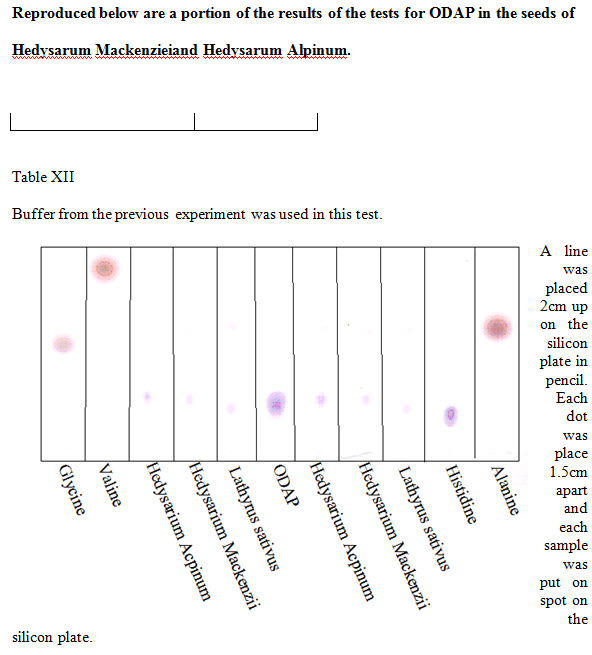
The sample was allowed to dry and then the plate was place in the TLC apparatus containing the solvent so that the plate had 1 cm of solvent on it.
It was then placed in the TLC apparatus.
Start TLC at 12:15 stopped it at 18:00
The plate was dried under the hood, then sprayed with ninhydrin. Again it was dried under the hood and finally scanned into the computer.
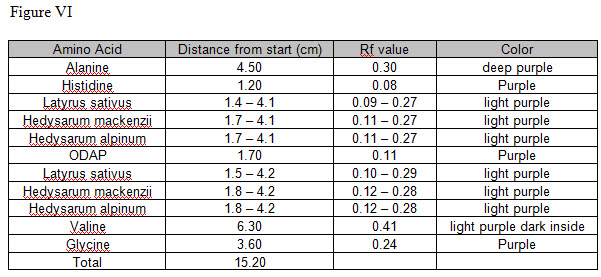
A line was placed 2cm up on the silicon plate in pencil. Each dot was place 1.5cm apart and each sample was put on spot on the silicon plate.
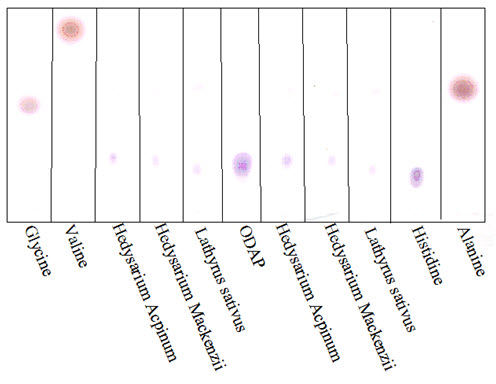
The sample was allowed to dry and then the plate was place in the TLC apparatus containing the solvent so that the plate had 1 cm of solvent on it.
It was then placed in the TLC apparatus.
Start TLC at 13:40 stopped it at 19:20
Dried in hood and sprayed with ninhydrin and again dried in hood.
Picture was scanned in computer for data analysis.